The last 14 seconds of video 07, which is where the face breaks. Same clip, same prompt naming the jaw, hair and face shape and demanding they hold through profile turns and fast movement, same two references — a frame of 07 from before the span, plus the cast sheet. 480p. Seedance 2.0 caps its input at 15 seconds, so 14 is the most one pass can carry.
Fraction of pixels moving more than 12 grey levels against the input.
| at | 2.0 fast | 2.0 | face region, fast | face region, 2.0 |
|---|---|---|---|---|
| 0.5s | 0.03 | 0.02 | 0.06 | 0.05 |
| 8s | 0.18 | 0.18 | — | — |
| 10s | 0.18 | 0.17 | 0.06 | 0.06 |
| 12s | 0.15 | 0.15 | 0.46 | 0.45 |
| 13s | 0.05 | 0.05 | 0.11 | 0.12 |
Top left is the cast sheet. Then the input at 0.5s, 10s, 12s, 13s; then 2.0 fast at the same four; then 2.0 at the same four.
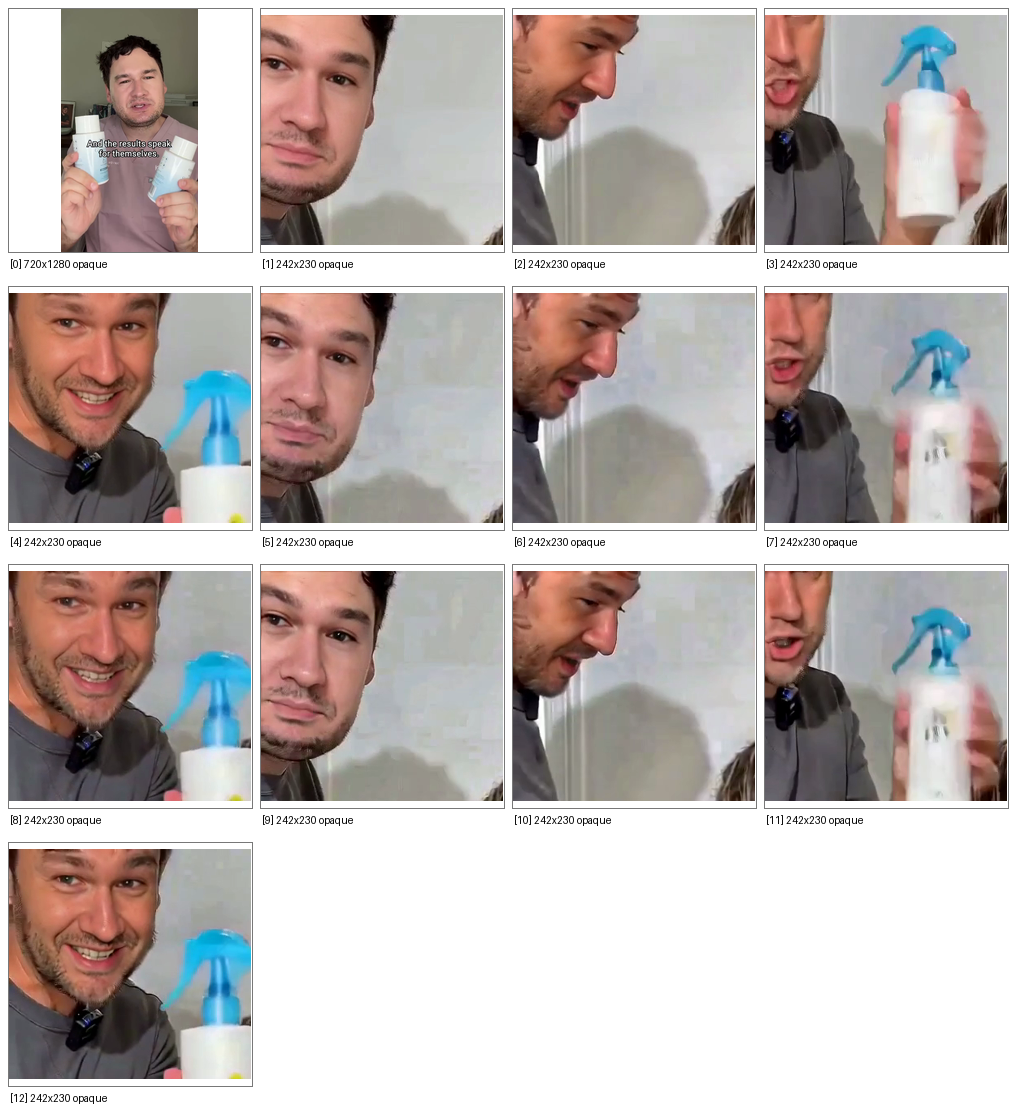
What this says. Both tiers DID rework the face area — 0.46 of it at 12 seconds — and both arrived at the same drifted face. An edit model preserves the identity already in the frame rather than re-deciding it, so a prompt insisting the man never changes does not override what the pixels already show. The drift was baked in by the original chunked generation, and an edit pass at any price does not undo it. The fix is a different class of tool, not a dearer tier: a face-swap pass for identity, or for the talking beats the house router's own rule — mouth only goes to InfiniteTalk at $0.03/s, never to Seedance — because a lip-sync tool holds the face by construction and only drives the mouth.